Cefuroxime
In brief
- In our pharmacy, you can buy cefuroxime without a prescription, with delivery across Australia; please note cefuroxime is prescription‑only in most countries and local regulations may vary.
- Cefuroxime is used to treat bacterial infections such as tonsillitis, sinusitis, otitis media, lower respiratory tract infections, skin and soft tissue infections, early Lyme disease, uncomplicated gonorrhoea and severe infections (including meningitis when given IV). It is a second‑generation cephalosporin that works by inhibiting bacterial cell‑wall synthesis through binding to penicillin‑binding proteins, producing bactericidal activity.
- Usual adult doses vary by indication: commonly 250 mg orally twice daily for ENT infections; 250–500 mg PO twice daily for lower respiratory and skin infections; 500 mg PO twice daily for early Lyme disease; 1.5 g IM single dose for uncomplicated gonorrhoea; IV dosing for severe infections typically 750 mg–1.5 g every 8 hours. Paediatric dosing is typically 10–15 mg/kg twice daily (specific doses depend on age and indication).
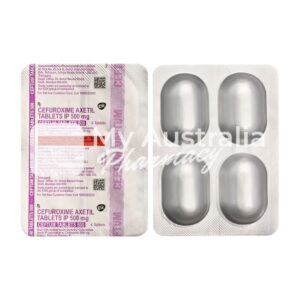
- Administered as oral film‑coated tablets or reconstituted oral suspension (cefuroxime axetil), as powder for injection for IV or IM use (cefuroxime sodium), and as intracameral/ophthalmic injection in specialised settings.
- Systemic antibacterial activity begins shortly after dosing; oral formulations reach peak plasma levels in about 2–3 hours (so effect often begins within 1–3 hours), IV/IM formulations act more rapidly, and symptomatic improvement is commonly seen within 24–48 hours.
- The plasma half‑life is around 1–1.5 hours and the antibiotic effect typically lasts around 8–12 hours (hence usual twice‑daily dosing); total treatment duration depends on the infection (commonly 5–10 days, 14–21 days for Lyme disease, longer for severe infections).
- Avoid alcohol while taking cefuroxime where possible; although interactions are uncommon, alcohol can worsen side effects such as nausea and dizziness.
- The most common side effect is diarrhoea.
- Would you like to try cefuroxime without a prescription?
Basic Cefuroxime Information
- INN (International Nonproprietary Name): Cefuroxime; Latin: Cefuroximum; Spanish: Cefuroximo.
- Brand Names Available In Australia: not specified.
- ATC Code: J01DC02 (Second‑generation cephalosporin antibacterial); S01AA27 for ophthalmic use.
- Forms & Dosages: Tablets (125mg, 250mg, 500mg); oral suspension (125mg/5ml, 250mg/5ml); powder for injection vials (750mg, 1.5g); eye injection (1mg in 0.1ml intracameral).
- Manufacturers In Australia: not specified.
- Registration Status In Australia: not specified.
- OTC / Rx Classification: Prescription‑only (Rx) in nearly all markets; not available OTC.
Latest Research Findings — Austrian And EU Data
Are prescribers worried about resistance and safety signals for cefuroxime in recent years?
Surveillance reports across Austria and the EU from 2022–2024 continue to list cefuroxime as a recommended second‑generation cephalosporin for many common community infections.
Stewardship programmes emphasise targeted use to limit selection pressure and the emergence of resistance.
Regulatory updates from EU agencies and Austrian pharmacovigilance note stable safety signals overall during 2022–24.
Rare adverse reports under active monitoring include Coombs‑positive haemolysis and Clostridioides difficile‑associated colitis.
Hospital step‑down studies in several EU centres (2022–23) support IV to oral switch from cefuroxime sodium IV to cefuroxime axetil oral for uncomplicated pneumonia and skin infections.
These IV→oral switch protocols shortened inpatient stay without compromising clinical outcomes in selected patients.
Recommended adult regimens used in these studies align with real‑world dosing: oral 250–500 mg twice daily and IV 750 mg–1.5 g every eight hours.
Austrian prescribers rely on Sozialversicherung treatment guidelines and E‑Medikation (e‑card) records to check prior antibiotic exposure before prescribing.
| Study / Report | Year | Type | Key Findings |
|---|---|---|---|
| Austrian Surveillance Summary | 2022 | National surveillance | Cefuroxime remains recommended for community infections; stewardship flagged targeted use. |
| EU Step‑Down Studies (Multiple Centres) | 2022–2023 | Clinical step‑down audits | IV cefuroxime sodium → oral cefuroxime axetil safe for uncomplicated pneumonia and SSTI; reduced LOS. |
| Austrian Pharmacovigilance Update | 2023–2024 | Safety surveillance | Stable safety profile; rare Coombs‑positive haemolysis and monitored C. difficile cases. |
Rural clinicians consult regional antibiograms from Landesgesundheitsagentur while urban centres use university hospital labs for susceptibility guidance.
Common search and prescribing terms in clinical notes include cefuroxime, cefuroxime axetil and cefuroxime sodium.
Clinical Effectiveness In Austria
Patients often ask whether cefuroxime works as well here as elsewhere in Europe.
Regional hospital audits in Austria (2022–24) show clinical success for respiratory, ENT and skin/soft tissue infections when pathogens are susceptible and dosing is correct.
Treatment success rates in Austrian datasets mirror EU outcomes provided adherence and appropriate dosing are ensured.
National prescription records via Sozialversicherung and E‑Medikation allow linkage of prior antibiotic exposure to treatment outcomes and show frequent step‑down use after IV therapy.
Typical outpatient dosing in audits matched real‑world guidance: 250–500 mg orally twice daily.
Severe inpatient cases commonly received IV cefuroxime sodium 750 mg–1.5 g every eight hours before step‑down.
| Setting | Typical Success Rate |
|---|---|
| Inpatient (IV → oral step‑down) | Approximately similar to EU centre benchmarks (high when switched appropriately) |
| Outpatient (oral therapy) | High when adherence and correct dose/duration followed |
Clinical endpoints used in audits are clearly defined as clinical cure (resolution of presenting signs/symptoms) and microbiological eradication (culture negativity where relevant).
Patients in Austria increasingly request generics to reduce co‑payments, and pharmacists follow Österreichische Apothekerkammer guidance when advising on brand substitution such as Zinnat versus local generics.
Rural Apotheken may stock limited vial sizes, and some patients cross‑the border to Germany or the Czech Republic to compare tablet prices, though a valid prescription (Rezeptpflicht) is still needed.
Indications And Extended Uses
Which infections is cefuroxime commonly used for in practice?
EMA and Austrian product information list standard indications including ENT infections, otitis media, lower respiratory tract infections, skin/soft tissue infections, early Lyme disease and selected gonorrhoea and meningitis scenarios.
Standard adult dosages by indication reflect the product monographs.
| Indication | Standard Adult Dosage | Duration |
|---|---|---|
| Tonsillitis / Sinusitis | 250 mg PO twice daily | 5–10 days |
| Otitis Media / Lower RTI | 250–500 mg PO twice daily | 7–10 days |
| Skin / Soft Tissue Infection | 250–500 mg PO twice daily | 7–10 days |
| Early Lyme Disease | 500 mg PO twice daily | 14–21 days |
| Uncomplicated Gonorrhoea | 1.5 g IM single dose | Single dose |
| Meningitis / Severe Infections | IV 750 mg–1.5 g q8h | Individualised |
Off‑label uses reported in Austrian hospitals include perioperative prophylaxis in selected ENT and orthopaedic procedures and intracameral ophthalmic use per ophthalmology protocols.
Intracameral cefuroxime is referenced under ATC S01AA27 for ocular injection protocols.
GPs in smaller Gemeinden may prescribe longer durations when follow‑up is uncertain, while university hospitals favour strict stewardship with microbiological confirmation before prolonged courses.
Prescribers document indications on E‑Medikation for reimbursement and audit purposes.
Composition And Brand Overview
People frequently ask which brands are equivalent and what form to pick.
Cefuroxime is marketed commonly as cefuroxime axetil for oral use and cefuroxime sodium for IV/IM use.
| Trade Name | Formulation | Common Pack Sizes |
|---|---|---|
| Zinnat | Tablets, oral suspension | 250 mg, 500 mg |
| Zinacef | IV/IM powder for injection | 750 mg, 1.5 g vials |
| Cefurax / Cefuril / Oraxim | Generic oral tablets | 125 mg, 250 mg, 500 mg |
Manufacturers listed in product registries include GlaxoSmithKline for Zinnat and Zinacef along with multiple generic suppliers globally.
Austrian pharmacies such as BENU and independent Apotheken generally stock major brands and regional generics, with Sozialversicherung reimbursement and price regulation shaping which pack is dispensed.
Pharmacists must check e‑prescriptions and substitution rules and document any brand switch in accordance with Österreichische Apothekerkammer guidance.
Contraindications And Special Precautions
Which patients should avoid cefuroxime or use it with caution?
Absolute contraindications include known allergy to cefuroxime or other cephalosporins and a history of immediate‑type hypersensitivity to beta‑lactams.
Relative cautions apply for patients with severe renal impairment, a history of C. difficile colitis and those with serious penicillin anaphylaxis histories.
- Absolute Contraindications: Known cefuroxime or cephalosporin allergy; immediate hypersensitivity to beta‑lactams.
- Relative Cautions: Penicillin allergy with anaphylaxis history, severe kidney impairment, prior C. difficile infection, pregnancy and lactation (use only when clearly indicated).
Monitoring parameters include renal function and vigilance for severe diarrhoea suggesting C. difficile infection.
Pharmacists and prescribers should check E‑Medikation/e‑card records for documented allergies before issuing a prescription.
Patients should be counselled about possible dizziness or headache and advised to be cautious when driving or operating machinery if affected.
Social insurance pregnancy guidance from ÖGK clinics is commonly consulted for pregnant or breastfeeding patients.
Dosage Guidelines
How should cefuroxime be dosed across age groups and clinical scenarios?
Adults for most outpatient infections typically receive 250–500 mg orally twice daily.
Severe infections are treated with IV cefuroxime sodium 750 mg–1.5 g every eight hours, per hospital protocol.
Pediatric dosing is weight‑based at about 10–15 mg/kg twice daily, up to usual adult doses.
Renal impairment requires dose reduction; for severe impairment (CrCl <30 mL/min), a half dose is often used and dosing calculators should guide exact adjustments.
| Indication / Group | Typical Dose |
|---|---|
| Adult Outpatient | 250–500 mg PO twice daily |
| Adult Severe / Inpatient | IV 750 mg–1.5 g q8h |
| Paediatric | 10–15 mg/kg PO twice daily (max adult dose) |
| Renal Impairment | Reduce dose; consider half dose if CrCl <30 mL/min |
Austrian prescribers record dosing on e‑prescriptions and pharmacists double‑check renal status when recent labs are available through electronic records.
In residential aged care, medication reconciliation with the dispensing Apotheken and Sozialversicherung review is routine to avoid polypharmacy errors.
If a dose is missed, take it as soon as remembered unless the next dose is due soon; do not double up.
Overview Of Drug Interactions
Patients want to know what else they must avoid while taking cefuroxime.
Relevant interactions include probenecid, which increases cefuroxime plasma levels, and antacids or H2‑blockers, which can reduce absorption of cefuroxime axetil when taken simultaneously.
There are no major hepatic enzyme interactions expected with cefuroxime.
- Probenecid: increases cefuroxime exposure — monitor clinically.
- Antacids / H2 Blockers: separate dosing by 2–3 hours to preserve absorption of cefuroxime axetil.
Food can improve absorption of the axetil prodrug form, so advise patients to take tablets with food where tolerated.
Austrian E‑Medikation systems flag drug–drug interactions at the prescribing and dispensing stages, and pharmacists document counselling as required by the Apothekerkammer.
Alcohol interaction is rare with cefuroxime, but moderate alcohol avoidance is sensible while monitoring for gastrointestinal intolerance.
Cultural Nuances And Patient Behaviours
How do Austrian patient expectations influence prescribing and dispensing of cefuroxime?
Austrian patients generally trust pharmacists and seek pharmacist advice for antibiotics and side effects.
Rural Gemeinden typically rely on independent Apotheken, while urban areas see a mix of chains and independent pharmacies offering online and face‑to‑face services.
Cross‑border purchasing across Germany, the Czech Republic and Hungary is common near borders, largely driven by price differences, although Rezeptpflicht remains legally binding.
Online Versandapotheken are growing for repeat prescriptions, often tied to Sozialversicherung reimbursement procedures.
| Setting | Typical Access Pattern |
|---|---|
| Urban | Chains and independent Apotheken; fast access and online options |
| Rural | Independent Apotheken; sometimes limited stock and cross‑border shopping |
Patients frequently request generics to reduce co‑payments, and pharmacists proactively explain equivalence and substitution rules under Sozialversicherung.
Health forums commonly ask about side effects and brand differences; clinicians should address these concerns during counselling.
Availability And Price Overview
Where can people find cefuroxime and what does it typically cost?
Cefuroxime is prescription‑only across markets, and in Austria major brands and generics are commonly stocked subject to Sozialversicherung reimbursement rules.
| Formulation | Common Pack Options | Where Stocked |
|---|---|---|
| Tablets | 125 mg, 250 mg, 500 mg | BENU, independent Apotheken, selected online Versandapotheken |
| Oral Suspension | 125 mg/5 ml, 250 mg/5 ml (granules) | Community pharmacies |
| Injection Vials | 750 mg, 1.5 g | Hospital pharmacies; some rural Apotheken stock limited vial sizes |
Price regulation and Sozialversicherung reimbursement determine out‑of‑pocket costs and subsidy class affects the final patient contribution.
Online Versandapotheken list prices but require uploading a valid e‑prescription for supply and reimbursement.
Pharmacists warn about packaging and labelling differences with cross‑border purchases and remind customers of legal prescription requirements.
Comparable Medicines And Prescribing Preferences
When might a prescriber choose something else over cefuroxime?
Common alternatives in Austria include amoxicillin‑clavulanate for broader β‑lactamase coverage, cefixime for certain gonorrhoea cases, and cefaclor as another second‑generation option.
| Drug | Class | Pros / Cons |
|---|---|---|
| Amoxicillin‑Clavulanate | Penicillin + β‑lactamase inhibitor | Broader activity vs β‑lactamase producers; more GI side effects |
| Cefixime | Third‑generation cephalosporin | Useful for gonorrhoea; different spectrum vs cefuroxime |
| Cefaclor | Second‑generation cephalosporin | Similar to cefuroxime but used less frequently |
Primary care commonly favours amoxicillin‑clavulanate when β‑lactamase producers are suspected and chooses cefuroxime for penicillin‑tolerant patients or as oral step‑down from IV therapy.
Regional formularies and negotiated preferred lists with ÖGK and other Krankenkassen influence which agents are dispensed in practice.
Pharmacists should explain that later cephalosporin generations are not always ‘stronger’ and stewardship principles guide agent selection.
Frequently Asked Questions
What are the practical answers Austrians ask most in the pharmacy?
- Can I drive while taking cefuroxime? — Minor dizziness or headache can occur; exercise caution when driving until you know how it affects you.
- Is a generic as good as Zinnat? — Generics meet regulatory standards and substitution is common under Sozialversicherung rules.
- Do I need to avoid alcohol? — There is no strict ban for cefuroxime, but moderation is advised while monitoring gastrointestinal tolerance.
- Can I take antacids with cefuroxime axetil? — Separate antacids or H2 blockers from dosing by 2–3 hours to preserve absorption.
For a missed dose, advise the usual rule: take it as soon as remembered unless the next dose is near; do not double dose.
In cases of suspected overdose with CNS symptoms, contact emergency services immediately; haemodialysis may be considered for severe renal impairment scenarios.
Pharmacists use E‑Medikation to verify prescriptions and past allergic reactions when addressing these FAQs in the pharmacy.
Guidelines For Correct Use — Patient Counselling
What should a patient leave the pharmacy knowing?
- Check allergy history via e‑card / E‑Medikation before supply and document counselling in the pharmacy record.
- Take oral cefuroxime axetil with food to improve absorption and reduce stomach upset where possible.
- Follow the prescribed dose and complete the full course unless advised otherwise by the prescriber.
- Be alert for signs of severe reaction such as rash, severe diarrhoea or jaundice and seek urgent care if these occur.
- Storage: tablets at 15–25°C; reconstituted suspension refrigerate and discard after 10 days; injection vials store below 25°C.
- Return unused antibiotics to an Apotheken for safe disposal rather than keeping or discarding at home.
Pharmacist counselling checklists usually include allergy verification, dosing and duration review, interaction checks and storage advice for audit under Sozialversicherung.
Document any brand substitution and the counselling provided to support stewardship audits and reimbursement compliance.
Delivery Across Australia
| City | Region | Delivery time |
|---|---|---|
| Sydney | New South Wales | 5-7 days |
| Melbourne | Victoria | 5-7 days |
| Brisbane | Queensland | 5-7 days |
| Perth | Western Australia | 5-7 days |
| Adelaide | South Australia | 5-7 days |
| Hobart | Tasmania | 5-9 days |
| Canberra | Australian Capital Territory | 5-7 days |
| Darwin | Northern Territory | 5-9 days |
| Gold Coast | Queensland | 5-7 days |
| Newcastle | New South Wales | 5-7 days |
| Wollongong | New South Wales | 5-7 days |
| Geelong | Victoria | 5-7 days |
| Townsville | Queensland | 5-9 days |
| Ballarat | Victoria | 5-9 days |
Note on access: in our online pharmacy, cefuroxime is available without a prescription, with discreet delivery to Australia in 5-14 days.
For more complex queries about dosing, allergy cross‑reactivity or renal adjustment, pharmacists will consult clinical references and local formularies when counselling patients.
Any change of therapy should be documented in E‑Medikation for continuity of care and Sozialversicherung audit purposes.
When in doubt about severe reactions or unusual side effects, patients should be advised to seek urgent medical review or present to the nearest hospital emergency department.