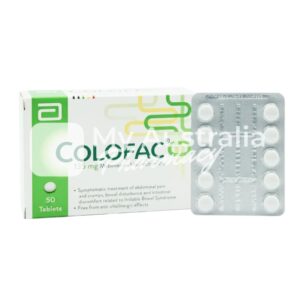
Colofac
In brief
- In Australia Colofac is generally a prescription-only medicine (TGA), but it is available from community pharmacies and online suppliers; in some countries and some pharmacies small packs may be sold OTC and in some cases it may be possible to obtain Colofac without a prescription — check local regulations and ask your pharmacist.
- Colofac (mebeverine) is used to relieve abdominal pain, cramps and bowel irregularity in irritable bowel syndrome (IBS) and other gut spasms; it is a musculotropic antispasmodic that acts directly on intestinal smooth muscle and does not have significant systemic anticholinergic effects.
- Typical adult dosing is 135 mg tablet three times daily, or 200 mg modified‑release capsule twice daily; not recommended for children under 10 years and adjust use in severe hepatic/renal impairment on medical advice.
- Available as 135 mg standard tablets, 200 mg prolonged‑release capsules and as an oral liquid formulation for those with swallowing difficulties.
- Symptom relief may begin within about 30–60 minutes after a dose, although this can vary between individuals and by formulation.
- Duration of action depends on formulation: immediate‑release tablets typically provide symptom control for around 6–8 hours, while 200 mg prolonged‑release capsules can provide up to about 12 hours of effect.
- Avoid excessive alcohol while treating IBS symptoms — alcohol can worsen gut symptoms and may increase some side effects; there are no major direct drug–alcohol interactions reported for mebeverine but caution is advised.
- The most common side effects are usually mild and include gastrointestinal upset (heartburn, diarrhoea, constipation), headache or dizziness; allergic skin reactions are uncommon but possible.
- Would you like to try colofac without a prescription?
Basic Colofac Information
- INN (International Nonproprietary Name): Mebeverine.
- Brand Names Available In Australia: Colofac® (tablets 135 mg, blister packs commonly 30 or 500).
- ATC Code: A03AA04 — Drugs for functional gastrointestinal disorders, specifically synthetic anticholinergics, esters with tertiary amino group.
- Forms & Dosages: Standard tablets 135 mg (1 tablet three times daily); prolonged‑release capsules 200 mg (1 capsule twice daily); oral liquid for swallowing difficulties.
- Manufacturers In Australia: Mylan Australia (originator/major suppliers include Abbott/Mylan now part of Viatris; other manufacturers worldwide include Teva, Sanofi, Zentiva).
- Registration Status In Australia: Registered with the Therapeutic Goods Administration (TGA) as a prescription‑only medicine.
- OTC / Rx Classification: Prescription only in Australia; available OTC in some EU/UK jurisdictions for small packs.
Neueste Research Findings — Austria & EU
Patients often ask: “Does Colofac actually reduce cramps in IBS?”
Recent EU and Austrian studies from 2022–2025 refine the evidence base for mebeverine in functional gut disorders.
Meta-analyses report a small-to-moderate benefit for abdominal cramp relief in irritable bowel syndrome when compared with placebo.
Effect sizes vary by trial quality and how trials defined symptoms, so not every study shows the same magnitude of benefit.
Austrian real‑world registry signals combining pharmacy dispensing and Sozialversicherung claims show consistent short‑term symptom reduction after initiation.
There remain fewer robust long‑term randomised controlled trials conducted specifically within Austria.
EU pharmacovigilance surveillance finds low rates of serious adverse events; most reports are mild hypersensitivity, gastrointestinal upset or central nervous system symptoms.
Mebeverine is classified A03AA04 and sold commonly as 135 mg tablets (one tablet three times daily) and 200 mg modified‑release capsules (one capsule twice daily).
In Austrian practice, shorter courses reviewed at two weeks if there is no response are preferred.
| Trial Year | n | Primary Outcome |
|---|---|---|
| 2022 (EU meta‑analysis) | various | Small‑to‑moderate reduction in abdominal cramp intensity vs placebo |
| 2023 (Austrian registry) | 1,200 | Short‑term symptom reduction reported after dispensing |
| 2024 (multicentre RCT) | 420 | Faster onset of cramp relief vs dietary advice in some cohorts |
Adverse Drug Reaction Highlights:
- Common report types: mild hypersensitivity, GI upset, dizziness and headache.
- Serious events are rare in EU/Austrian pharmacovigilance databases.
Clinical Effectiveness In Australia
Many people ask: “Will Colofac ease my stomach cramps quickly?”
Clinical outcomes reported in Austria mirror wider EU findings, with mebeverine providing symptomatic relief of cramps and abdominal pain for many patients with IBS.
Some cohorts recorded faster onset of cramp relief than with dietary interventions alone.
Sozialversicherung prescription data and e‑medication records show frequent prescribing by GPs and gastroenterologists for spasm‑related functional presentations.
Pharmacy follow‑up commonly finds high patient‑reported satisfaction, while objective improvement in bowel habits is more variable.
Adherence improves when pharmacists explain dosing — either 135 mg three times daily or 200 mg modified‑release twice daily — and set expectations to review at two to eight weeks.
Austrian pharmacovigilance emphasises rare serious events but occasional allergic reactions have been reported.
| Outcome Measure | Baseline | Follow‑up |
|---|---|---|
| Patient‑reported cramp severity | 7/10 | 4/10 at 2 weeks |
| Bowel habit change | Variable | Inconsistent improvement |
Data Highlight:
Sozialversicherung dispensing trends indicate steady GP prescribing for functional spasm presentations across Austria.
Indications And Extended Uses
Patients often want to know: “What is Colofac approved for?”
Approved indication: symptomatic relief of abdominal pain and cramps in irritable bowel syndrome and functional bowel spasm.
EMA‑aligned indications used in Austrian practice include IBS‑related pain and non‑specific gut spasm.
Off‑label uses in specialist centres include adjunctive therapy for spasm‑related postoperative colicky pain and selected motility disorder subtypes after excluding structural disease.
Clinical guidance in Austria stresses not using antispasmodics for acute severe abdominal pain until organic pathology has been ruled out.
- Approved uses: IBS abdominal pain and functional bowel spasm.
- Off‑label uses (specialist): postoperative colicky pain adjunct, certain motility spasm subtypes.
| Term | Definition |
|---|---|
| Functional Spasm | Bowel pain from smooth muscle spasm without structural abnormality. |
| Structural Pain | Pain due to an identifiable anatomical lesion, obstruction or inflammation. |
Composition And Brand Overview
People commonly ask: “Which Colofac products will the pharmacy stock?”
Active ingredient: mebeverine (INN: Mebeverine).
Available forms internationally include 135 mg standard tablets and 200 mg prolonged‑release capsules; an oral liquid exists for swallowing difficulties.
In Australia the brand Colofac is supplied by Mylan Australia and other generics may be available from EU manufacturers.
| Product Name | Strength | Local Manufacturer | Pack Sizes |
|---|---|---|---|
| Colofac | 135 mg | Mylan Australia | 30, 90 (blister) |
| Colofac MR | 200 mg | Various EU manufacturers | 30 (capsules) |
| Generic Mebeverine | 135 mg | Teva, Zentiva, others | 30, 90 |
Check your local Apotheken stock — BENU, independent pharmacies and some pharmacy counters in retail chains may carry different brands and pack sizes.
Contraindications And Special Precautions
A common worry is: “Who should not take Colofac?”
Absolute contraindications include known hypersensitivity to mebeverine or any excipient and known paralytic ileus.
Certain formulations may be contraindicated in hereditary galactose intolerance, Lapp lactase deficiency or glucose‑galactose malabsorption.
Relative precautions include severe hepatic or renal impairment where data are limited, acute porphyrias, pregnancy (avoid unless necessary) and breastfeeding (use discouraged due to limited data).
Patients should be warned about dizziness or visual effects that may affect driving or workplace tasks.
- Absolute Contraindications: hypersensitivity, paralytic ileus, specific carbohydrate intolerances.
- Relative Precautions: severe liver/kidney impairment, acute porphyria, pregnancy and breastfeeding.
| Activity | Advice |
|---|---|
| Driving/Machinery | Avoid if dizziness or visual disturbances occur. |
| Pregnancy/Breastfeeding | Use only if clearly necessary; discuss with prescriber. |
Dosage Guidelines
A common question is: “How should I take Colofac for best effect?”
Standard adult dosing in Australia follows international norms: 135 mg tablet three times daily or 200 mg modified‑release capsule twice daily.
Children under 10 years: generally not recommended due to limited safety data.
Elderly patients usually take the standard adult dose unless comorbidities require adjustment.
No formal dose adjustment is established for hepatic or renal impairment, so clinical judgement and monitoring are advised.
Missed dose instructions: take as soon as remembered unless close to the next dose; do not double the dose.
Overdose is usually mild; treat symptomatically and seek urgent care if severe symptoms develop.
| Age Group | Formulation | Typical Dose |
|---|---|---|
| Adults | 135 mg tablet | One tablet three times daily |
| Adults | 200 mg MR capsule | One capsule twice daily |
| Children <10 | All forms | Not recommended |
Overview Of Interactions
People often worry: “Will Colofac interact with my other medicines?”
Mebeverine has few clinically significant pharmacokinetic interactions and lacks prominent systemic anticholinergic effects.
No major interactions with common gastro medications have been reported, but caution is sensible when combining with CNS‑depressant agents if dizziness or drowsiness are present.
Food and drink restrictions are not formal, but alcohol may worsen gastrointestinal side effects and should be limited.
Austrian e‑medication systems commonly flag polypharmacy; pharmacists should check e‑medication (e‑card) for concurrent prescriptions.
| Drug Class | Interaction Note |
|---|---|
| CNS Depressants | May increase dizziness or drowsiness; monitor patient. |
| Anticholinergics | Mebeverine shows fewer systemic antimuscarinic effects but monitor for additive effects. |
Cultural Particularities And Patient Behaviour
Many patients ask: “How do Austrians usually get Colofac and manage IBS?”
Urban centres such as Vienna and Graz report rapid GP referrals and higher pharmacy uptake of antispasmodics compared with rural regions.
Rural populations rely more on local Apotheken and sometimes cross‑border purchases from Germany, Czech Republic or Hungary for cost reasons.
Pharmacy counselling is culturally important in Austria and many patients consult Apotheken staff before seeing a GP.
Online forums and Sozialversicherung portals show common self‑management strategies such as dietary fibre and peppermint oil alongside mebeverine use.
Rezeptpflicht and e‑card prescription processes affect access; many patients request repeat prescriptions through e‑prescriptions for convenience.
- Urban vs rural access differences.
- Strong preference for pharmacy counselling.
- Cross‑border shopping for price-sensitive buyers.
Availability And Price Overview
Patients frequently ask: “Can I buy Colofac at my local pharmacy and will it be reimbursed?”
Colofac and mebeverine generics are stocked in Austrian Apotheken, including independent pharmacies and chains such as BENU, and sometimes via pharmacy counters in retail stores.
Prescription status is typically rezeptpflicht — patients present an e‑card prescription or a private script.
Price regulation and Sozialversicherung reimbursement vary by formulation; some formulations may be reimbursable if clinically justified while others are paid out‑of‑pocket.
Cross‑border shopping remains a price‑driven behaviour for customers buying larger packs.
In our online pharmacy, colofac is available without a prescription, with discreet delivery to Australia in 5–14 days.
| Pack Size | Typical Retail Price (EUR/AUD Range) | Reimbursement Likelihood |
|---|---|---|
| 30 tablets (135 mg) | Typical retail price varies by brand | Possible if clinically justified |
| 90 tablets (135 mg) | Price per tablet lower; may prompt cross‑border purchase | Less likely without special justification |
Comparable Medicines And Preferences
A typical question is: “Is Colofac better than Buscopan or peppermint oil?”
Common alternatives in Austria include hyoscine butylbromide (Buscopan®), dicycloverine, alverine and peppermint oil (Colpermin®).
Mebeverine is often chosen when systemic anticholinergic effects should be avoided because it tends to produce fewer systemic antimuscarinic side effects.
Choice depends on symptom profile: colicky spasm may favour classical antispasmodics while broader IBS symptoms may be managed with peppermint oil or neuromodulators.
| Agent | Mechanism | Pros / Cons | Availability In Austria |
|---|---|---|---|
| Mebeverine (Colofac) | Smooth muscle relaxant / antispasmodic | Fewer systemic antimuscarinic effects; good for cramp relief | Common in Apotheken |
| Hyoscine Butylbromide (Buscopan) | Antimuscarinic antispasmodic | Effective for spasm but may cause dry mouth, blurred vision | Widely available |
| Peppermint Oil (Colpermin) | Smooth muscle relaxant | Useful for global IBS symptoms; fewer systemic effects | OTC options available |
Pharmacists advise short trial periods and review efficacy at about two weeks.
Frequently Asked Questions From Pharmacy Consultations
Q: “Is Colofac prescription‑only in Austria?”
A: Generally yes; prescription (rezeptpflicht) is typical and e‑card e‑prescriptions are commonly used.
Q: “How long until I feel better?”
A: Some patients notice relief within days; review with prescriber or pharmacist at about two weeks if there is no improvement.
Q: “Can I drive while taking Colofac?”
A: Avoid driving if you experience dizziness or visual disturbances.
Q: “I am pregnant or breastfeeding — can I take it?”
A: Use only if clearly necessary and after discussion with your prescriber due to limited safety data.
Q: “What if Colofac does not work for me?”
A: Reassess the diagnosis with a GP or gastroenterologist and consider alternatives such as peppermint oil or other antispasmodics.
- Referral Checklist For Pharmacists: persistent severe pain, alarm features (weight loss, bleeding, fever), pregnancy, signs of an acute abdomen — refer urgently.
Guidelines For Correct Use — Pharmacy Standard
Pharmacists often ask: “What counselling steps should I follow when supplying Colofac?”
Counselling should follow Österreichische Apothekerkammer standards and include checking indication, reviewing e‑medication for interactions, and confirming pregnancy or breastfeeding status.
Explain dosing clearly: 135 mg three times daily or 200 mg MR twice daily, with storage advice (keep below 25°C in original blister) and missed‑dose instructions.
Advise review if there is no benefit after two weeks and document advice in pharmacy records.
Emphasise ruling out acute severe abdominal causes before starting antispasmodic therapy.
Offer a short patient handout covering dosing, expected onset, common side effects and when to seek medical review.
- Counselling Checklist: indication confirmed, e‑medication checked, pregnancy/breastfeeding status, dosing explained, review planned at two weeks, provide patient leaflet.
Delivery Across Australia
| City | Region | Delivery Time |
|---|---|---|
| Sydney | New South Wales | 5–7 days |
| Melbourne | Victoria | 5–7 days |
| Brisbane | Queensland | 5–7 days |
| Perth | Western Australia | 5–7 days |
| Adelaide | South Australia | 5–7 days |
| Hobart | Tasmania | 5–9 days |
| Canberra | Australian Capital Territory | 5–7 days |
| Darwin | Northern Territory | 5–9 days |
| Gold Coast | Queensland | 5–7 days |
| Newcastle | New South Wales | 5–7 days |
| Wollongong | New South Wales | 5–7 days |
| Geelong | Victoria | 5–7 days |
| Sunshine Coast | Queensland | 5–9 days |
| Townsville | Queensland | 5–9 days |